Linnworks couldn’t reorder.
So we built the engine it was missing.
Linnworks is a capable order & warehouse system — but as a re-order tool it leans on static, hand-typed min/max levels. For a 10,000-SKU battery distributor, that meant overstock and stockouts at the same time. Here's how we replaced its reorder logic with a demand-driven engine that actually explains itself.
An order system with reorder stapled on
The root failure is simple: in Linnworks, reorder points are static, manually-maintained min/max levels per SKU. Every suggestion is only as good as the number a human last typed — and those go stale the moment demand shifts. Everything else cascades from that one architectural choice.
“Once a suggestion needs full manual verification before you can action it, it isn't a suggestion — it's just a list.”
⚠ Open-PO blindness
Reorders against on-hand, not on-hand + on-order. Stock already in flight on a live PO doesn’t suppress a fresh suggestion — so you double-order. Clean, repeatable, expensive.
⚠ No defence against spikes
One big trade order inflates a SKU’s run-rate and Linnworks treats it as steady demand — over-ordering for weeks off a single lumpy line, with nothing to flag the number is unsafe.
⚠ No MOQ awareness
Suggests “order 37” when the supplier ships in 24s. Every figure needs hand-correcting against pack sizes and minimums before it becomes a real PO.
⚠ No explainability
Every suggestion is a black box of static thresholds with no derivation. Staff can’t sanity-check it — which quietly destroys trust in the whole feature.
The twin consequence: overstock on slow movers (cash tied up, shelves full) and stockouts on fast movers (lost sales, panic POs) — happening simultaneously, because the levels driving both were typed in once and forgotten.
A reorder screen that shows its working
Instead of a black box, every line carries its derivation and a confidence rating, so the lowest-confidence lines surface first for review. Below-MOQ lines are flagged for a one-click bump, and stock already on a PO is counted before anything new is raised. The headline change isn't the maths — it's that a buyer can read why.
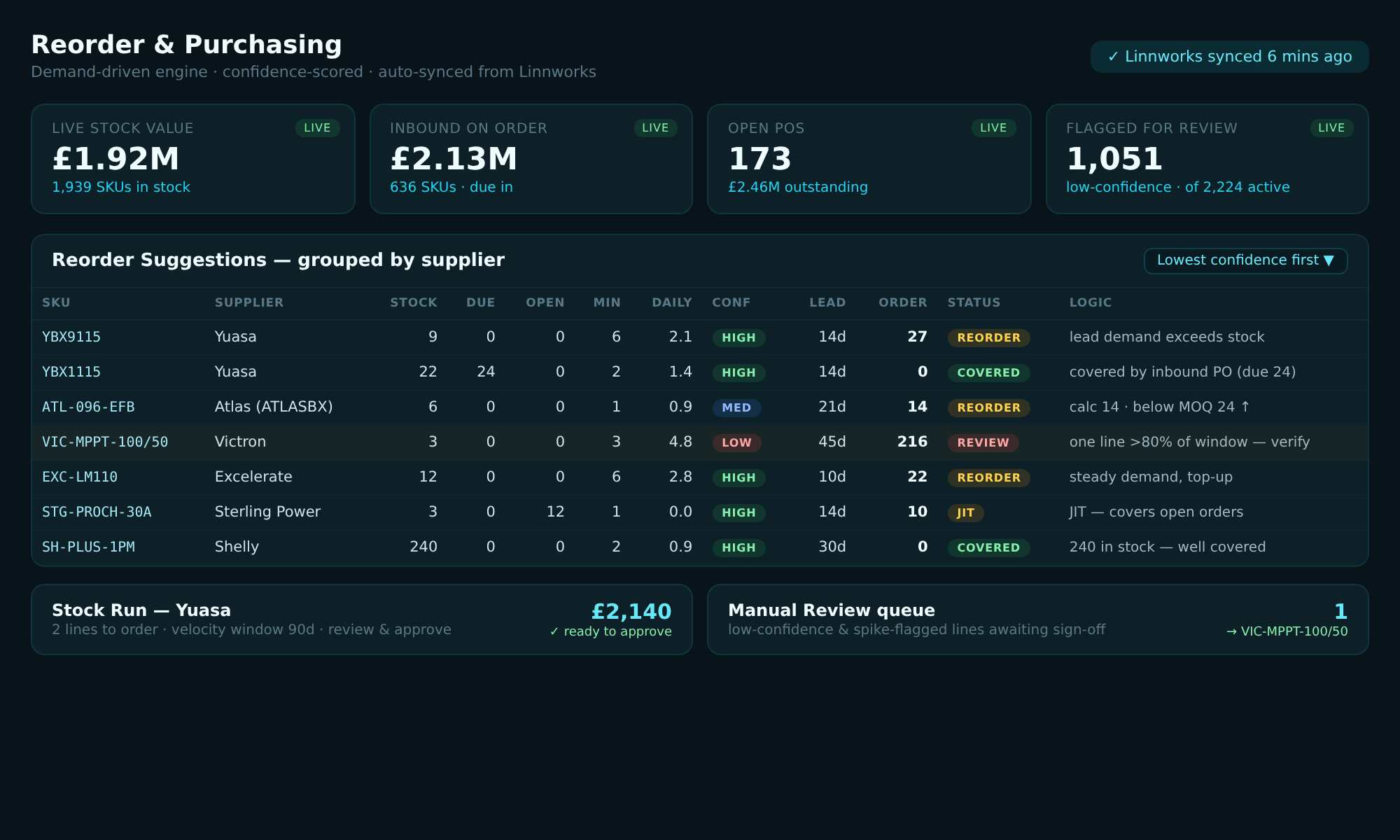
The two-formula engine
Each SKU is routed by a Just-In-Time flag. Supply is common to both: Supply = Stock + Due — where Due (on-order) is the exact open-PO fix Linnworks lacked.
// JIT products — don't hold stock, just cover committed demand
Order = MAX(0, Open Orders + Effective Min − Supply)

// Non-JIT products — forecast-driven
Lead Demand  = Lead Time × Daily Average
Cycle Demand = Order Cycle × Daily Average   (if cycle ordering on)
Order = MAX(0, Open Orders + Lead Demand + Cycle Demand + Effective Min − Supply)
A near-zero forecast collapses to “cover committed demand only”, and the quantity is computed once per canonical SKU so renamed variants never double-count. Below-MOQ lines are flagged for a one-click bump — surfaced for the buyer, not silently rounded.
Every line knows how much to trust itself
Each suggestion is scored against the active velocity window (not lifetime sales) on three tests: how many distinct order lines it has, whether one order is more than 80% of the window's demand (a lumpy spike), and whether it's gone stale (>45 days since the last sale). The result is a four-level confidence rating, so a buyer trusts the High bulk at a glance and reviews the handful that scored Low.
Nearly half score Low — the exact lines Linnworks would have actioned blind. The engine routes them to a human instead.
Linnworks stays the source of truth
A deliberate boundary: the integration is read-heavy by design. A wrong write to a live warehouse system is expensive and hard to unwind; a bad read just makes a suggestion you can ignore. So Linnworks remains the system of record, and the tooling is read-only intelligence on top.
The right cost, with a paper trail
Linnworks' single cost field is the root of bad reorder economics and bad margin. The replacement is a best-available-cost priority chain — a replacement-cost basis that answers “what would it cost to restock this today”.
In practice the chain resolves cleanly: 76% of live stock value is costed straight from a real purchase order, 16% from Sage, and the rest from manual or Excel fallbacks — with only 30 in-stock SKUs left flagged for review. And it self-heals: fix a wrong cost in Linnworks and it corrects on the next sync.
From a list you re-check to a tool you action
Linnworks reorder
Where forecasting still needs a human
No forecast is perfect. A single large trade order can still inflate a SKU's run-rate and skew its suggested quantity — the same failure mode we levelled at Linnworks. Outlier-trimming the raw daily-rate is the next refinement on the list.
The difference is the engine knows when to doubt itself. That skew doesn't pass silently — it drops the line's confidence to Low, so it surfaces for review before a buyer approves it. The engine runs automatically on auto-synced Linnworks data; the human stays in the loop exactly where judgement is needed.
Running Linnworks and fighting your reorder?
If your min/max levels are typed in and forgotten, there's a better way — built on top of the Linnworks you already run, without betting the warehouse on automated writes. Let's talk.
Book a free discovery call